

Do you have peonies in your garden or cutting garden, but can't grow the same peony flowers you see at the florist? In this blog, you'll read how to grow your own peonies in your garden and which peony varieties are suitable for this!
Placement and care of your plant
Always check the species-specific instructions that come with the plant to see how much sun and space the plant needs and what soil requirements it has. With a few exceptions, most peonies prefer full sun and do best in an open part of the garden with well-draining soil.
Autumn is the best time to plant peonies. The peony will establish better, and it will require less work in the autumn because nature will provide water for you. In September, we and other growers harvest the peony plants from the ground, and they are sorted. So, when you receive them in the autumn, you get plants fresh from the ground, which can be directly planted in the garden. At this time, the peony above ground is dormant, but the roots will already be forming root hairs in the soil, allowing the plant to establish itself in your garden. This promotes growth in the spring.
Always hydrate the rhizomes with water before planting them. Do not plant the peony rhizomes deeper than 5cm into the ground. If the peony is planted too deeply, it will not produce flowers. In milder climates, 2-3 cm below ground is recommended so that the "noses" (growth points) really get some cold. It is advisable to mix compost into the topsoil.
Peonies are large, heavy flowers. It is a good idea to support the plant using a support ring. Fertilize the plant twice a year to stimulate growth, in autumn and early spring. In spring, also cut away any remaining leaves and stems.
Read more information in this blog: Caring for your peony plant
Plant size
It all starts with the peony plant you put in the ground. A cut flower grower cuts their peonies from healthy mature plants. It is therefore important to plant a healthy mature peony plant in your garden, as this gives the best chance of having flowers within one or two years.
An adult peony plant needs not only two or three older thicker roots but also many thinner younger roots to establish itself well in the soil. In addition, the number of growth points indicates the maturity of the plant. Over the years, a peony plant produces more growth points. These growth points eventually develop into stems with flowers. The number of growth points is often indicated online as 1/2, 2/3, 3/5, or 5+. These numbers represent the number of growth points a plant has. So, 1/2 means the plant has 1 or 2 growth points. Sometimes this is not mentioned, and only a pot size is given.
For example, you might see P9. This refers to a pot with a diameter of 9 centimeters. To convert this to growth points, you can use this overview:
P9 = 1/2 growth points
P13 = 2/3 growth points
P17/P19 = 3/5 growth points
P21/23 = 5+ growth points.
In this blog, you can read more about this topic: How to assess the maturity of a peony rhizome online
Peony varieties for cutting flowers
In theory, you can, of course, cut flowers from any type of peony. But the plant habit, the length and size of the stem, and the appearance of the flower mean that some varieties are better suited for cutting flowers than others. Well-known varieties for cutting include:
Peony Sarah Bernhardt
A true classic that every cut flower peony grower has in their assortment. Peony Sarah Bernhardt produces soft pink flowers with beautiful long sturdy flower stems. After a few years, it already produces more than 10 flower stems per plant, and because it is one of the last varieties to bloom, you have a long peony season.

Peony Alexander Fleming
In many respects, it resembles Sarah Bernhardt. The only difference is the color; otherwise, you would think it was the same flower. The Alexander Fleming has a dark pink color with beautiful long sturdy flower stems.

Peony Duchesse de Nemours
A white peony is always more difficult to grow into a cut flower than other colors. With Duchesse de Nemours, it will certainly succeed. With some support during growth, it produces beautiful long stems with a magnificent double white flower. The blooming period is in the middle of the peony season.

Peony Red Charm
This red beauty is one of the most beloved peonies. Peony Red Charm doesn't produce the longest flower stems, but it makes up for it with the size of its flowers. It also blooms early in the peony cutting season, allowing you to enjoy it early.

Peony Coral Sunset
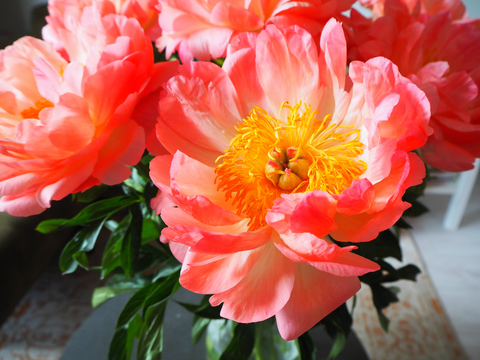
The peony Coral Sunset is another early bloomer. This variety particularly stands out for its unique flower color. As the name suggests, the flower has a coral-like color. It starts quite dark but gradually lightens in color.
Discover our entire Peony assortment here.
Do you have any questions about our plants? Feel free to ask, we are happy to help you further!
